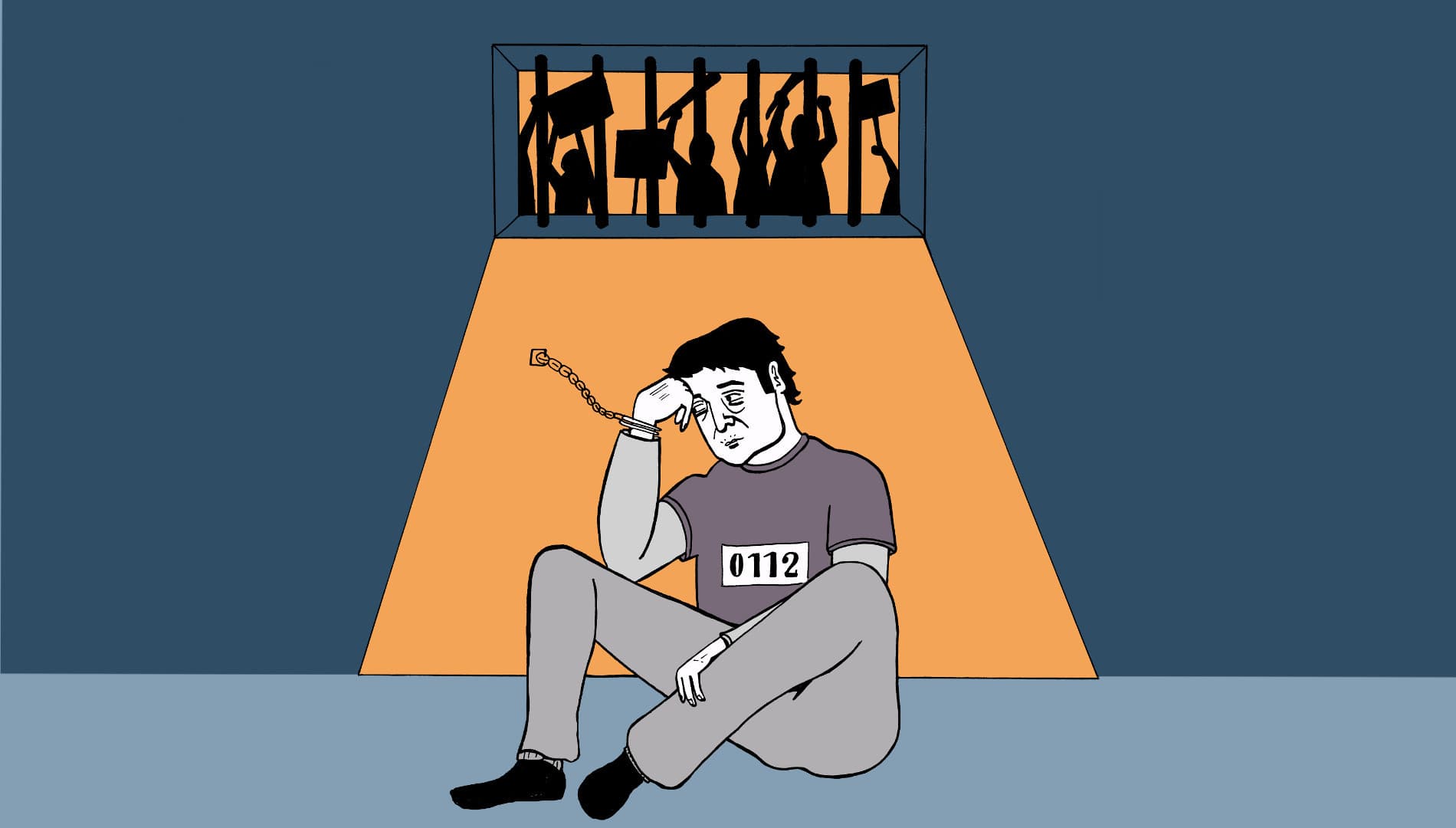
Today’s news feed is extremely full of negativity, and it is very easy to get lost in it. And worst of all, to lose the motivation to act in the right direction, because it seems that nothing is changing for the better.
We hasten to assure you that this is not the case at all: the struggle for justice continues, and the forces of good in this struggle are only growing stronger and taking the shape of the constructive structures that will shape the development of a better society in the future.
But let us get to the heart of our message, namely: why we should remember one of the most important fronts in the struggle for justice — the civic and political activists who are behind bars.
A great deal has been said about solidarity and the need for support, but sometimes these words are not enough to keep up the motivation to fight for the repressed for years. Let us look at this question from a practical point of view and understand more deeply the urgent need to write every letter to a political prisoner and send every kilogram in a parcel to a prison or colony.
First of all, one very important point should be made: solidarity with the prisoners of the dictatorship is not a sprint. We would all very much like to overthrow the criminal regime as quickly as possible and calmly put aside our human rights projects, enjoying the triumph of law and justice.
Everyone who has no support from the outside needs attention.
A former political prisoner released from IK-2, Babruisk
Unfortunately, that is not how things work, and the most powerful positive changes in society are won at the greatest sacrifice. So we should all accept that solidarity with political prisoners and supporting them is a long process, a difficult and demanding marathon that we have no right to lose to the bloody regime.
And now back down to earth and to purely practical matters.
Political imprisonment itself — in custody, in prison or in a colony — is a punishment for a person’s civic stance or political views. In other words, the aim of this bacchanalia, often accompanied by torture and abuse, is to break undesirable ideals or personal qualities of the individual. Hence all the horrors we hear about from administrative and criminal prisons and detention centres. Horrors that many have experienced first-hand, more than once.
It is very important for political prisoners to know that they are not forgotten and are remembered, and any attention from outside — whether a letter, a parcel or a money transfer — helps them avoid depression and withdrawal, and remember that everything happening on their life path now is not in vain. After all, everything in this system is geared towards finding a way to leave a person alone with themselves and break their will.
A political prisoner serving a sentence in an open-type correctional facility (IUOT)
And if the system tries to break what is best in a person, then obviously that is exactly what frightens the dictatorship most of all. It is precisely these qualities and views that we must support first and foremost. This is a very important point that is often underestimated.
A political prisoner is not just a body inside four walls, deprived of normal sleep, contact with the world and food. It is a person who has done something, often the most important thing in their life. A person who chose action or speaking out over fear of an entire state repressive machine. Such a person has a whole range of feelings, emotions and attachments, and doubts too. One way or another, even the most uncompromising opponent of the regime, sitting on a square metre of cold concrete, has wondered: “why did I need all this?”
Your support in the form of letters to people in such places is priceless.
I couldn’t have imagined what an absorbing process it is. Letters are what give us a chance to take our minds off what is going on around us. Solidarity is very important. But what surprises me most is that most people here have simply forgotten and don’t even want to know what is happening now. When you fall asleep in the Volodarsky SIZO and hear the parties going on at Niamiha, you have mixed feelings. But I will just say that we must not forget about these people — they are suffering for all of us right now.A former political prisoner sentenced to “home chemistry” (restricted freedom without being sent to an open-type facility) for taking part in protests
This is exactly where we must come to the rescue, because the entire system of prisons and camps, from the operative officer down to the last nail in the wall, is created and works with a single aim — to break the prisoner’s ideals and personality.
Grey walls, an aggressive social environment that is only stirred up by the administration and its provocations, meagre food, constant pressure from the staff, isolation — all this is meant to create in a person the illusion that their position is wrong and that the horror being done to them is lawful.
It is hard to overestimate how much even a single letter means in such a situation — a letter telling the prisoner that they are a hero and that what they did is a real source of pride, felt right now by the whole progressive world. Dissidents themselves constantly compare letters to a breath of fresh air that lets them escape the lawlessness around them for a moment, immerse themselves in the everyday life of a person on the outside, travel with them and experience a host of feelings and emotions.
And this is the simplest thing one can do.
If there is money in the account, you can buy all the essentials, because far from everyone has the bare minimum. Not everyone has time to queue with parcels, and that’s if there is anyone to do it at all. Support in letters is very important; the hope that everything will change for the better gives strength. Unfortunately, many receive no help at all — they have no relatives, or their relatives don’t know what to do.
A former political prisoner in the “Zeltser case”
How can you support political prisoners?
- Come to open court hearings to show your support with your presence, get to know the prisoners’ loved ones and exchange contacts;
- Send telegrams, postcards and letters, both offline and online via the services Pismo.bel or Maisternia Pashtovak Salidarnastsi (Solidarity Postcard Workshop);
- Help order books from a shop following the instructions. For example, in Turma №1 prisoners can receive books via oz.by (see Nikolay Autukhovich’s profile and the “send a book” button), and in Turma №8 you can even send a book in a first-class envelope to those transferred to the prison regime (see Oleg Rubets’s profile). Likewise, the administrations of IK-2 and IK-5 also accept books for prisoners;
- Until the sentence has entered into force (the appeal has not yet been heard), you can send money to the political prisoner’s personal account (this is a reliable option, as the money always arrives!). All payment details are given on the main page of the website or in the prisoners’ profiles;
- Become a Keeper for a specific prisoner and help them regularly;
- Spread information about political prisoners by any means available.
You can always find answers to your questions or ask your own in the FAQ section.
Podcasts with former political prisoners (who, sadly, have ended up behind bars again) and well-known activists in the CIS countries.